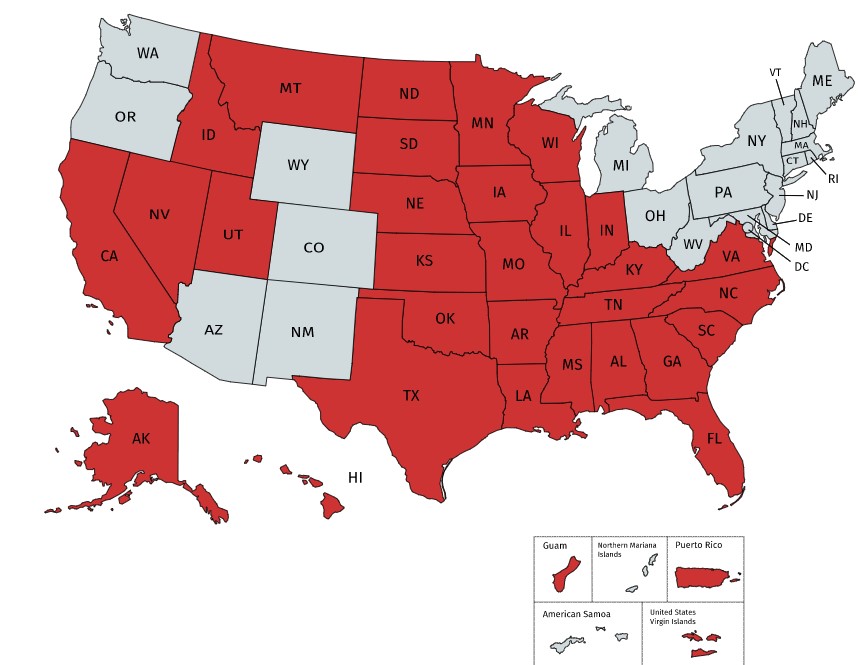
Today, Governor Andrew Cuomo added Alaska and Montana to the travel advisory. There are now a total of 33 states and U.S. jurisdictions impacted by the travel advisory. Individuals coming into New York, New Jersey and Connecticut from these areas must quarantine for 14 days under Executive Order 205 (the Order) and the Department of Health issued Interim Guidance for Quarantine Restrictions on Travelers Arriving in New York State Following Out of State Travel (the Guidance). We examine some frequently asked questions about the Order and the Guidance below.
What is the effective date of the travel restriction?
The Order is effective as of 12:01 a.m. on June 25, 2020 for the originally covered states and 12:01 a.m. on the date immediately following the day on which States are added or removed. For the two states being added today, the Order will be effective as of 12:01 a.m. Wednesday, September 2.
What are the metrics for determining what areas are impacted?
A state qualifies for a travel restriction if it has either (1) a new daily positive test rate higher than 10 per 100,000 residents over a seven-day rolling average, or (2) higher than 10% positivity rate over a seven-day rolling average. According to the Guidance, New York will announce the impacted states on a weekly basis.
What states are currently impacted?
As of September 1, there are 30 states and three territories impacted. They are the following:
|
Alabama |
Illinois |
Montana |
Tennessee |
Who does the travel advisory apply to?
According to the Guidance, the travel advisory does not apply to individuals traveling through the designated states for a limited duration of less than 24 hours. The Guidance lists examples of “brief passage” to include stopping at rest stops or layovers for air, bus or train travel.
If, however, a person has spent more time in the impacted states, they must quarantine. The Order applies to all New Yorkers and all visitors entering the state.
Importantly, the Guidance differentiates how the travel restriction applies to essential workers. We discuss this in more detail below.
What are the requirements of quarantining?
The Guidance sets forth specific measures to quarantine. They include:
Are there exemptions to the quarantine order?
Yes. The first exemption is the transitory exemption detailed above, where a person travels through one of the impacted states and spends less than 24 hours within the state.
The second exemption applies to essential workers. The Guidance defines three types of essential workers:
How does the quarantine order apply to essential workers?
It depends on the length of the essential workers’ stay in New York.
Short term: essential workers traveling to New York for a period of less than 12 hours, including deliveries and layovers.
Medium Term: essential workers traveling to New York for a period of less than 36 hours, requiring an overnight stay. This includes deliveries and longer layovers.
Long Term: essential workers traveling to New York for a period of greater than 36 hours, requiring them to stay for several days.
Can people violating the order be reported?
Yes. Please see the Guidance for further instruction on how reporting works.
What are the enforcement measures?
New York has the power to issue quarantine orders and fines under the Order. Non-compliance with a quarantine order may lead to a civil penalty of up to $10,000.
If you have questions, or want to effect the standards applicable to your industry, please contact Hermes Fernandez, Caitlin Anderson or the attorney at the firm with whom you are regularly in contact.